


Flood insurance in Bartow, FL is one of the most widely misunderstood aspects of Central Florida property protection. Many property owners mistakenly assume that flood coverage is only a necessity for coastal estates or properties sitting dead center in a high-risk FEMA flood zone. However, that is simply not how inland hydrology behaves across Polk County. In Bartow, intense convective summer storm cells, flash-flooded streets, overtaxed municipal storm drains, and retention systems backing up near regional creeks and lakes create severe property damage well outside traditional map boundaries.
Bartow Flood Insurance: Quick Takeaways
- The Inland Reality: Heavy tropical rain accumulations routinely bypass FEMA maps. Low-lying roads near the Peace River basin and older downtown infrastructure regularly experience rising ground water intrusion.
- The Homeowners Policy Gap: Standard homeowners insurance policies never cover water entering your home from the outside ground up. True flash flood or rising stormwater recovery requires a standalone flood policy.
- NFIP vs. Private Markets: While the federal government’s National Flood Insurance Program provides standardized protection, the private Florida flood market often yields higher building limits, shorter waiting periods, and replacement cost coverage for personal items.
- The Independent Advantage: Think Safe Insurance operates as an objective broker, actively cross-matching your property’s specific elevation traits against multiple private flood markets to find competitive regional rates.
At Think Safe Insurance, we help Bartow property owners compare federal National Flood Insurance Program (NFIP) structures alongside rapidly expanding private flood insurance options. Flood safety across Central Florida is no longer a one-size-fits-all map equation. While homeowners near Lake Hancock may require maximum structural limit caps, families in master-planned communities like James Pointe, Laurel Meadows, or Wind Meadows are often more vulnerable to flash ground saturation after consecutive days of tropical downpours.
Bartow’s distinct real estate footprint features a complex blend of historic multi-generational homesteads near the city center and modern builds pushing outward along U.S. 98 and State Road 60. These varying construction styles, foundation configurations, and local drainage elevations mean that water hazards look completely different from one street corner to the next. Because protecting your household asset matters, your insurance protection must be customized to how water actually moves through your specific block—not just what a generic government map outlines.
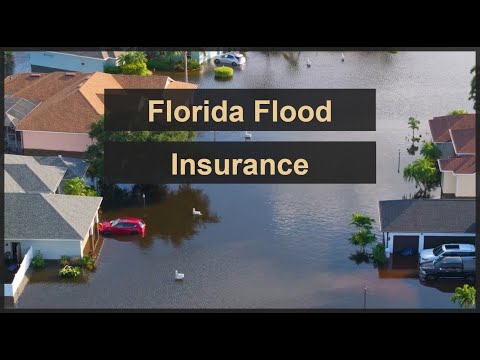
Navigating Bartow’s Unique Flood Challenges
Topographical flooding across Bartow is rarely caused by a single point of structural failure. More frequently, it is a cumulative effect combining Central Florida’s flat geographical layout, intense convective downpours, soil saturation limits, and localized civil drainage infrastructure.
During extended tropical depressions or severe summer storm setups, areas framing Old Bartow Lake, Lake Hancock, and the low-elevation Peace River basin see rapid water accumulation and severe drainage back-ups. Even homes boasting an immaculate, completely dry historical record can suddenly face major rising water exposure when days of relentless rain fill the underground water table, leaving surface runoff with nowhere else to drain.
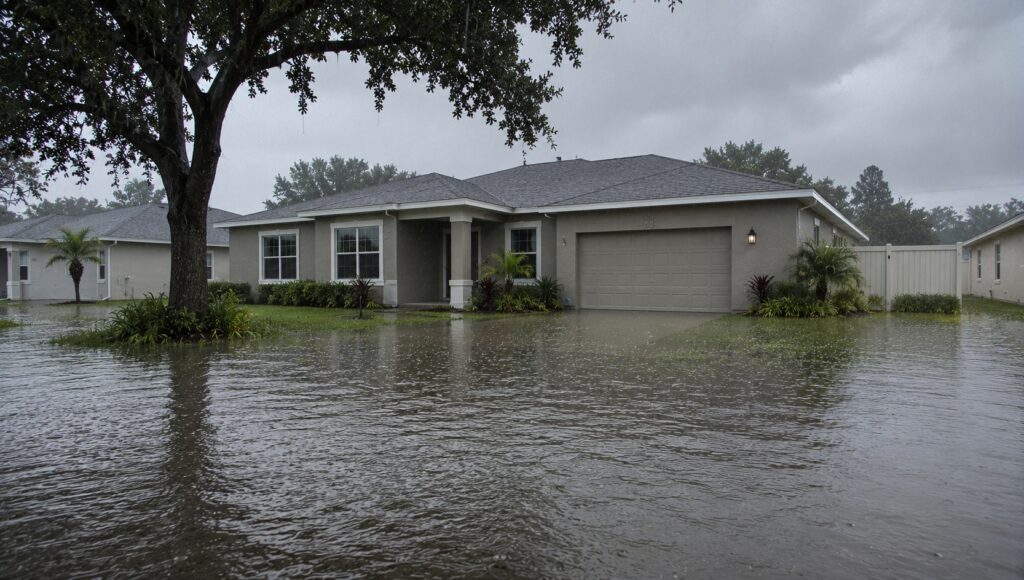
Major high-growth transportation routes like U.S. 17, U.S. 98, and State Road 60 significantly influence regional hydrology during a storm. Heavy asphalt sheet runoff can overflow municipal ditches and divert volumes of fast-moving water directly into adjacent residential avenues. Near downtown Bartow, some elements of the civil drainage infrastructure were engineered decades ago—long before the city expanded with modern commercial developments and dense sub-neighborhood grids.
While newer master-planned developments like Laurel Meadows and Wind Meadows integrate modern retention pond networks, they are not immune to rising water hazards. Many property owners are shocked to discover that localized retention reservoirs can actively compound the threat during high-volume tropical events if local overflow lines saturate faster than regional channels can discharge.
Bartow’s geographical position deep inside the Florida peninsula often generates a false sense of security compared to coastal communities managing ocean storm surges. However, inland flash flooding from stalled tropical depressions remains one of the costliest causes of structural property damage across Polk County. Long after hurricane winds diminish, slow-moving systems dump trillions of gallons of rainfall over saturated interior counties.
This reality is exactly why FEMA flood maps can be misleading. A flood zone map is merely a mathematical estimate of long-term probability using historical baselines—it does not dictate exactly where water will stop. Year after year, a significant percentage of all Florida flood insurance claims develop in areas officially classified as low-to-moderate risk “Zone X” environments.
Demystifying Florida Flood Insurance Coverage Options
It is vital to establish that flood protection is completely distinct from standard Florida homeowners insurance. Standard hazard policies explicitly exclude structural damage triggered by external rising water entering the foundation from the outside ground up.
Whether water pushes past your doorway due to a saturated street sewer, pooling lawn runoff, or rising lake lines, recovering from that loss requires a dedicated, independent flood insurance policy. A comprehensive strategy covers two distinct protection areas:
Building Property Coverage
Building coverage ensures the physical core structure of your dwelling is protected. This allocation applies directly to your foundation systems, central electrical and plumbing lines, HVAC systems, hot water heaters, built-in kitchen appliances, drywall layout, and permanent flooring features. For properties positioned in lower-lying terrain near drainage systems, this forms your absolute financial baseline.
Personal Property (Contents) Coverage
Contents protection focuses entirely on your unattached personal belongings located inside the main living space, including furniture ensembles, home electronics, apparel, and free-standing household appliances. On many federal insurance forms, contents protection must be added explicitly as an optional coverage layer. We strongly advise reviewing this allocation closely, as outfitting an entire home after a total water loss can easily cost tens of thousands of dollars out-of-pocket.
NFIP vs. Private Flood Insurance Markets
The National Flood Insurance Program (NFIP) is managed directly by the federal government and offers standardized underwriting frameworks across the country. However, the private flood insurance sector has expanded massively across Florida, providing a highly competitive alternative for modern properties.
Private property insurance structures often deliver massive advantages over traditional federal policies, including building limits exceeding the standard $250,000 NFIP cap, loss-of-use coverage to fund temporary housing expenses while your home is undergoing repairs, replacement cost terms for your personal property, and the total elimination of the standard 30-day federal waiting period.
The Independent Agency Advantage in Polk County
Working with a captive or single-line insurance agent restricts your options to one corporate underwriting template. If that single carrier updates its local restrictions or carries high pricing models for inland Polk County ZIP codes, you are completely out of alternative avenues.
Think Safe Insurance operates on an entirely independent brokerage model. We do not work for a single insurance carrier; we work directly for you. We analyze your home’s exact elevation data, roof age, and structural characteristics across multiple top-rated private and public flood programs to locate the optimal balance of competitive premiums and seamless asset safety nets.
Frequently Asked Questions About Bartow, FL Flood Insurance
Do I need flood insurance in Bartow if I am not in a FEMA high-risk flood zone?
Yes, it is highly recommended. FEMA maps simply evaluate localized historical risk averages—they do not prevent storms from overflowing local roads. Saturated residential streets, expanding commercial concrete runoff, and back-ups near Lake Hancock routinely trigger property damage across areas labeled as low-risk zones on government maps.
Can flood insurance help if heavy rain floods my home near U.S. 98 or State Road 60?
Yes. If external surface water pools and breaches your home’s threshold, a standalone flood policy is designed to cover the resulting structural and personal property damage. Standard home policies will not cover this type of loss.
Is private flood insurance better than NFIP coverage in Bartow?
It depends entirely on your home’s individual profile. Many modern properties in subdivisions like Wind Meadows qualify for highly competitive private flood rates with much higher structural limits and faster onboarding periods. However, for older historic homes near downtown, a traditional NFIP structure may remain your most stable option. We shop both markets to find your ideal fit.
Get a Local Bartow Flood Insurance Review

Managing your flood risk across Central Florida requires looking closely at how our intense weather, localized drainage, and civil growth patterns actually intersect. You deserve real, clear data over generic online pricing algorithms. We can also help with your Bartow homeowners insurance and Bartow auto insurance as well!
To cross-shop your property across the entire private and public Florida flood market, contact Think Safe Insurance today at your local Polk line at 863-356-4600 or start your online analysis now:
When you think insurance… Think Safe.


Last Reviewed: May 2026